Hindalco Industries Limited is rapidly reshaping its business model as it moves beyond its legacy identity as a commodity aluminium producer toward becoming a supplier of advanced, high-value materials for future-ready industries. Increasingly, recent company disclosures point to a decisive strategic pivot toward downstream, technology-intensive segments that align closely with India’s manufacturing expansion and self-reliance goals.
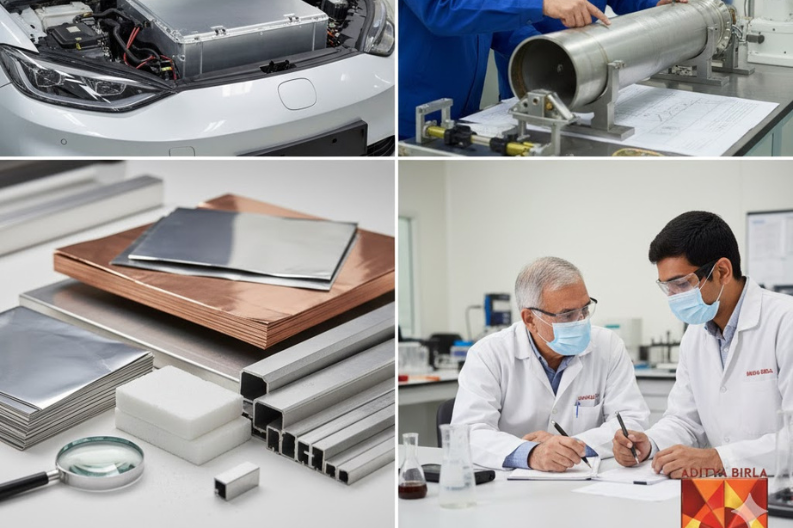
At the centre of this transformation lies aluminium’s expanding role in electric vehicles and defence applications. As mobility and security priorities evolve, requirements such as lightweighting, strength, thermal management and sustainability have become critical. Consequently, Hindalco has begun manufacturing aluminium battery enclosures for four-wheeler electric vehicles, marking the first time such products have been made domestically using aluminium. These enclosures weigh roughly 110 kilograms per vehicle and enhance battery durability and vehicle safety while meeting strict quality standards. Moreover, the company has already secured annual orders for around 150,000 vehicles. Going forward, it plans to extend supplies to additional original equipment manufacturers and energy storage systems.
In parallel, the company is expanding its battery materials portfolio. Notably, Hindalco is scaling up production of aluminium battery foils and copper foils used in lithium-ion cells. As a result, the company is positioning itself to cater to a growing customer base of cell manufacturers. At the same time, these materials offer higher margins compared to conventional flat rolled products. Therefore, the move represents not only a technological shift but also a structural improvement in earnings quality.
Meanwhile, Hindalco’s downstream aluminium operations are making steady inroads into aerospace and defence-grade materials. In support of India’s Atmanirbhar Bharat initiative, the company supplies billets, sheets, plates and extrusions made from specialised alloys to organisations including ISRO, DRDO, defence shipbuilders and missile programmes. Importantly, these applications demand precise metallurgical control, high-purity inputs and advanced processing capabilities. Consequently, they reinforce the company’s transition from volume-driven metal production to value-added manufacturing.
Another key pillar of this strategy is specialty alumina. Here, Hindalco is developing products such as specialty alumina, white fused alumina, high-purity alumina and precipitated hydrates. These materials find applications across batteries, electronics, refractories and advanced ceramics. Over time, several offerings have progressed from pilot stages to commercialisation, while capacity expansion plans are already underway. As a result, specialty alumina enables the company to reduce exposure to commodity price cycles. And build long-term demand visibility in niche segments.
Furthermore, these downstream and specialty initiatives are backed by substantial capital investments across India. These include new rolling capacity, battery foil mills, extrusion upgrades and recycling facilities. Management expects premiumisation and an improved product mix to structurally lift EBITDA per tonne, even without relying on favourable commodity price movements.
Taken together, Hindalco push into EVs, batteries and defence reflects a broader effort to align with long-term trends such as electrification, domestic manufacturing, sustainability and circularity. Ultimately, by embedding itself deeper into future-facing industries. The company is repositioning aluminium not merely as a metal, but as a strategic enabler of India’s next phase of industrial growth.