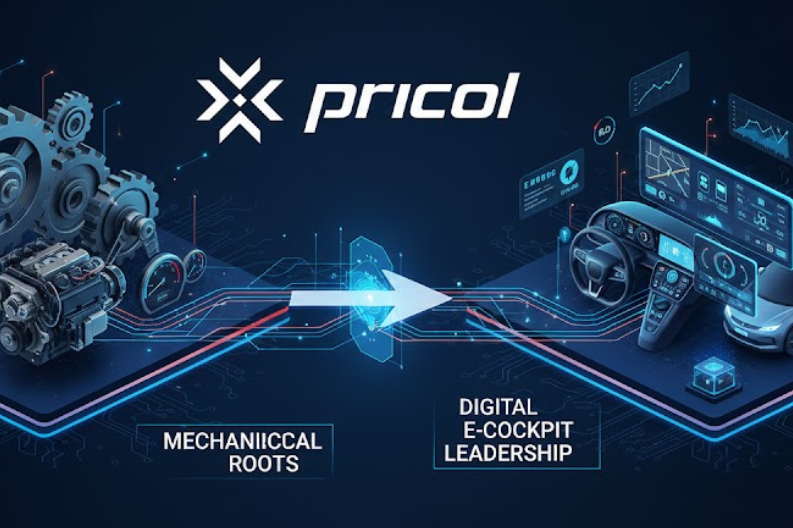
Pricol Transformation is reshaping the identity of Pricol Limited as the company moves decisively from mechanical systems toward digital, software-led automotive technologies. Founded in 1975, Pricol has traditionally built its reputation on mechanical and electromechanical components. However, according to its Q2 and H1 FY26 earnings call and investor presentation, the company is now firmly aligning itself with the future of electric vehicles (EVs) and connected mobility by expanding its electronics and digital systems portfolio.
Historically, Pricol focused on mechanical assemblies that formed the backbone of conventional vehicles. Over time, however, shifting OEM requirements and rapid technological change pushed the company to adapt. As a result, Pricol steadily expanded into electronics, driver information systems, and connected vehicle solutions. Today, its portfolio includes digital instrument clusters, smart e-cockpits, telematics systems, heads-up displays, and battery management systems. Consequently, these offerings directly support vehicles that rely on software-driven interfaces and real-time data integration.
During the Q2 FY26 earnings call, management clearly articulated this journey as an evolution “from mechanical to electromechanical to electronics.” Importantly, this shift is not aspirational alone; instead, it already reflects in financial performance. In Q2 FY26, consolidated revenue from operations reached about ₹988 crore, while EBITDA stood at ₹123.35 crore. Therefore, higher-value electronic products increasingly contribute to revenue alongside traditional businesses, signaling a structural change in Pricol’s value mix.
Moreover, a central driver of this change is the company’s Driver Information and Connected Vehicle Solutions (DICVS) vertical. This business houses digital clusters and e-cockpit technologies that form the digital interface between vehicle and driver. During Q2 FY26, Pricol launched several LCD and hybrid instrument clusters for OEMs such as Tata Motors, Bajaj, and TVS Motor Company. Notably, these products serve both internal combustion engine vehicles and EV platforms. As a result, Pricol strengthens its relevance across current and next-generation vehicle architectures.
Beyond product launches, Pricol is also investing in backward integration and advanced electronics manufacturing. The company entered a technology collaboration for optical bonding and screen-related processes. This initiative aims to reduce import dependence while improving cost competitiveness. Although such projects may not generate immediate revenue, management emphasized that they significantly strengthen electronics capability and support margin sustainability over time.
In parallel, research and development plays a critical role in this transition. Pricol employs over 470 product and process engineers and operates two technology centers. Approximately 4.5% of revenue goes into R&D. Consequently, this sustained investment supports innovation in digital interfaces, connected systems, and e-cockpits designed for EVs and future mobility solutions.
Meanwhile, the broader industry faces challenges such as semiconductor supply disruptions and regulatory shifts. Even so, management expressed confidence in navigating these headwinds through diversification, alternate sourcing, and strategic planning.
Ultimately, Pricol Transformation reflects a broader reinvention underway among legacy automotive suppliers. As automakers increasingly demand integrated digital solutions rather than standalone mechanical parts, Pricol’s combination of manufacturing scale, electronics expertise, and system-level offerings positions it as a long-term partner in the evolving EV and connected vehicle ecosystem.