Indian Railway Finance Corporation is undergoing a subtle yet meaningful shift in its earnings profile, and IRFC’s evolving margin story reflects that change clearly. Long recognised for its low-risk, low-return cost-plus lending model to Indian Railways, the PSU financier is now steadily expanding its net interest margins (NIMs). Importantly, this transformation is unfolding without diluting its core strength of asset quality and credit discipline.
In the first half of FY 2025-26, IRFC reported an annualised NIM of 1.55%, up from about 1.42% a year earlier. At first glance, this rise may appear incremental. However, for a lender managing assets under management exceeding ₹4.6 lakh crore, even a small basis-point improvement materially boosts profitability. Consequently, margin expansion at this scale has a disproportionate impact on earnings.
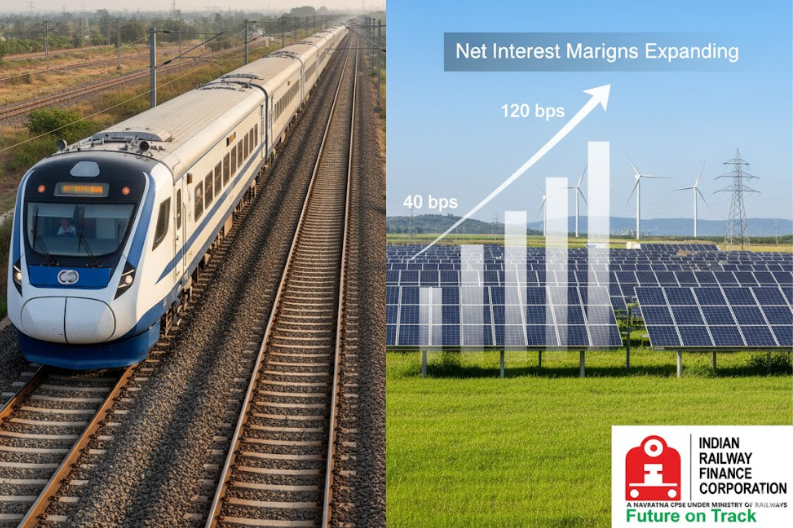
Historically, IRFC’s margins remained capped due to its business structure. The company primarily financed rolling stock and railway infrastructure through cost-plus lease agreements with Indian Railways. These contracts typically yielded spreads of nearly 40 basis points, reflecting sovereign backing and near-zero credit risk. As a result, IRFC achieved stability, predictable cash flows, and a consistent record of zero non-performing assets. However, this same stability also limited margin upside.
More recently, IRFC has begun reshaping its margin profile through strategic diversification beyond Indian Railways. During H1 FY26, the company signed more than ₹45,000 crore worth of agreements with non-railway entities. These included power generation companies, renewable energy firms, and other government-linked infrastructure players. As a result, lending spreads on these assets now range between 100 and 120 basis points, nearly three times higher than traditional railway financing.
Crucially, higher margins have not translated into higher risk. IRFC continues to lend within a “whole-of-government” framework, focusing on central public sector enterprises, state-owned utilities, and government-backed joint ventures. Therefore, despite expanding into new sectors, the company reported nil gross NPAs in H1 FY26, maintaining its long-standing asset quality record.
Moreover, management has repeatedly underlined that diversification remains selective rather than aggressive. The company prioritises borrowers with strong balance sheets, predictable revenues, and implicit or explicit government support. Thus, profitability improves while the risk profile stays largely unchanged. In addition, IRFC benefits from its low cost of funds and top-tier credit ratings, which further protect margins.
When compared with other PSU NBFCs, IRFC’s NIM still sits at the lower end of the spectrum. Many infrastructure lenders operate with margins closer to 2.5-3%. However, those higher margins often come with greater exposure to private-sector or cyclical risks. In contrast, IRFC’s approach favours steady margin expansion over rapid risk-led growth.
Notably, the impact already shows in financial performance. IRFC posted a profit after tax of ₹3,522.67 crore in H1 FY26, registering double-digit year-on-year growth. Meanwhile, revenue from operations remained broadly stable, reinforcing the role of margin improvement in driving earnings.
In essence, IRFC’s journey from 40 basis points to 120 basis points reflects discipline, scale, and careful execution rather than dramatic change. Over time, this quiet margin expansion may emerge as one of the strongest long-term value drivers for the company.