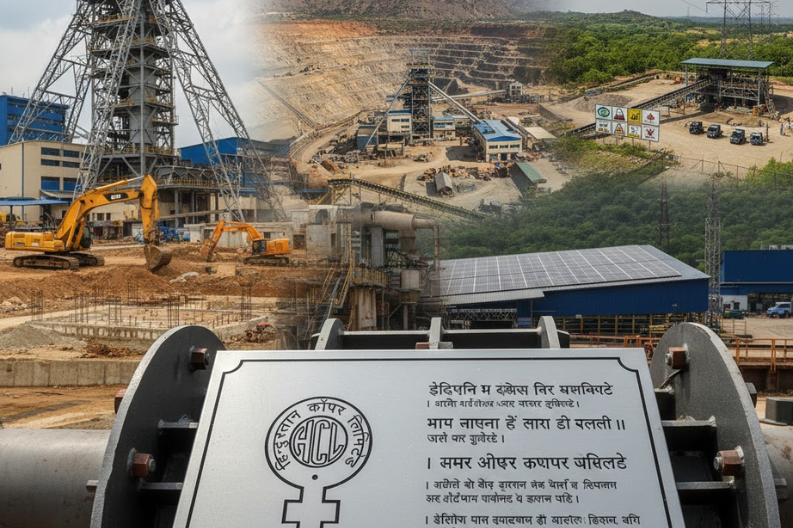
Kolkata: Hindustan Copper Limited (HCL), India’s only vertically integrated copper miner, has launched an ambitious expansion plan to sharply raise its mining capacity over the next six years. As India prepares for a surge in copper demand driven by infrastructure development, renewable energy, and electric mobility, the company aims to strengthen its strategic role in the domestic minerals landscape.
According to recent corporate disclosures and investor presentations, HCL plans to scale its mine capacity from nearly 4 million tonnes per annum (MTPA) to 12.2 MTPA by FY 2030-31. To achieve this, the company has committed a capital expenditure of about ₹2,000 crore spread across the next five to six years. This expansion reflects a decisive shift toward long-term growth and operational scale.
Importantly, the capacity expansion focuses on HCL’s three core mining regions-Malanjkhand in Madhya Pradesh, Khetri in Rajasthan, and the Indian Copper Complex in Jharkhand. At Malanjkhand, currently the company’s largest producing asset, HCL plans to raise output to 5 MTPA by FY31. It will do so by expanding underground operations, equipping shafts, installing a new concentrator plant, and commissioning paste fill facilities. As a result, Malanjkhand will remain the backbone of the company’s future production.
Meanwhile, in Rajasthan, the company will increase production at the Khetri and Kolihan mines to a combined 2.9 MTPA. It will achieve this through capacity augmentation and improvements in beneficiation infrastructure. Consequently, the region will play a stronger supporting role in meeting overall production targets.
However, the most notable transformation will occur in Jharkhand. After securing critical forest and environmental clearances, HCL has restarted operations at the long-closed Surda, Kendadih, and Rakha mines. Together, these mines are expected to contribute about 4.3 MTPA by FY31. Notably, Rakha will operate under a Mine Developer-cum-Operator (MDO) model, introducing a revenue-sharing structure that marks a first for underground metal mining in India.
At the same time, management has linked the expansion to India’s broader push for self-reliance in critical minerals. Although copper consumption continues to rise, India still contributes only a small share of global copper production. And depends heavily on imported copper concentrate. Moreover, per capita copper consumption in India remains well below global averages. Therefore, upcoming investments in metro rail, renewable power, electric vehicles, and urban infrastructure will further intensify demand.
Against this backdrop, Hindustan Copper Limited positions its expansion as a strategic response to reduce import dependence. Once the new capacities come online, the company expects a substantial increase in copper-in-concentrate output, which will directly support domestic smelters that rely on overseas supplies.
Nevertheless, execution challenges persist. Underground mining requires heavy capital investment and advanced technical capabilities. Production also remains sensitive to monsoon conditions, geological complexity, and long equipment lead times. For instance, shaft equipping at Malanjkhand may take more than two years. While mine ramp-ups will occur gradually rather than instantly.
Even so, HCL enters this phase from a position of strength. In FY 2024-25, the company recorded its highest-ever revenue, profit, and dividend payout. Consequently, a stronger balance sheet now supports the funding of large-scale investments.
If delivered as planned, this ₹2,000-crore programme could redefine India’s copper mining ecosystem. Ultimately, Hindustan Copper may emerge as a central pillar in securing domestic copper supplies for the country’s industrial and energy future.